A WINDOW, A DOOR, A TESSERACT AND THE WORLD
23.09.17 > 04.11.17
Fernando Santos Gallery, Porto, Portugal
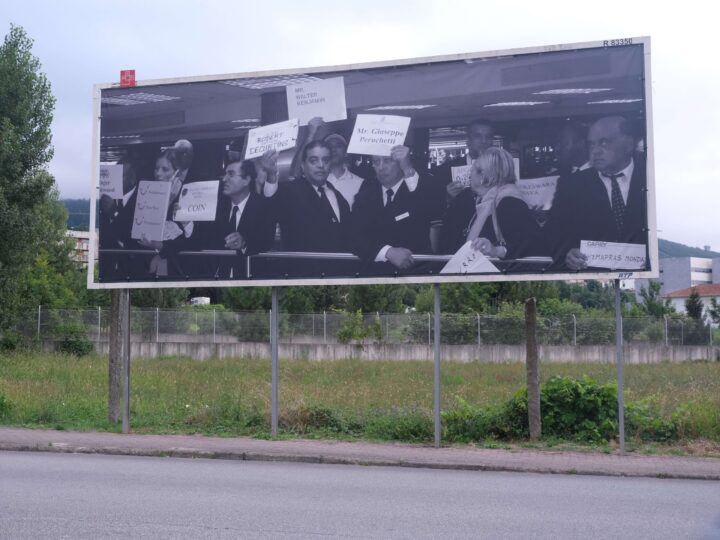
The previously unseen works presented in this project follow on from earlier investigations, focusing on the revision of the visual universe, the superimposition of images (which produce the new “black”), a distrust of the image, and the contemporary possibilities of the non-visual and the invisible.
It is therefore on this threshold—between the physiological questions of vision, in what the brain adds to what the eye sees, and the questions posed by the artist through the work, which speak from a world in its era of hyperreality and hyperactivity—that the broadest field of action is established, and it is within this field that the four works presented here are also situated.
Within the artist’s interest in architecture, seen in works such as “Site Scenes”, “Wittgenstein’s House”, “Buster Keaton’s House”, among others, the work “Hades” is inscribed—the door to the realm of the underworld. In Greek mythology, Hades was the god responsible for governing the subterranean world, a world without images, rich in the dead and their souls.
This group also includes “Window”, a window pushed against the wall, supported by a beam fixed to the floor. From the pressure on the other side, a without-an-outside—dark and superimposed—prevents its visualization. This is probably the blind spot of the hyperactive and hyperreal world.
“Tesseract” is the work that connects all the others on display. It is a hypercube, a cube in the fourth dimension. The reflection developed over time through “Blind Images” (an unfinished project), on the image and excess, leads to the idea that the plane of the image (or its absence), which calls upon language, develops and transforms into an object. In this new phase of “Blind Images”, textual inscriptions assume unusual positions; they multiply, becoming tesseractic, and enter a new dimension. The image is now object and the text is a pretext. “They Live by Night,” a film by Nicholas Ray, is what is recounted in this first tesseract.
The work is accompanied by a set of studies on paper—wandering approximations to the exhibited object, without defining the whole, in a state of fluctuation, with no up or down, only silence and darkness.
Finally, the project ends with “World.” A planisphere on canvas, in that anthropocentric vision that dissolves. The world that fits in the palm of the hand: crumpled paper, a writer’s discard.
UMA JANELA, UMA PORTA, UM TESSERATO E O MUNDO
23.09.17|04.11.17
GALERIA FERNANDO SANTOS, Porto, Portugal
As obras inéditas apresentadas neste projecto incluem-se no seguimento de investigações anteriores, que se centram na revisão do universo visual, na sobreposição de imagens (que produzem o novo “negro”), na desconfiança perante a imagem e nas possibilidades contemporâneas do invisual e do invisível.
É pois nessa margem, entre as questões fisiológicas da visão, naquilo que o cérebro acrescenta ao que o olho vê, e as questões que o artista coloca através da obra — e que falam desde o mundo na sua era de hiper-realidade e de hiperactividade —, onde se estabelece a área mais vasta da sua acção, que está presente também nestas quatro obras apresentadas.
No seu interesse pela arquitectura, em obras como as “Site Scenes”, a “Casa de Wittgenstein”, a “Casa de Buster Keaton”, entre outras, inscreve-se a obra “Hades” – a porta do reino do submundo. Na mitologia grega, Hades era o deus responsável por governar o mundo subterrâneo, um mundo sem imagens, na riqueza dos mortos e das suas almas.
Nesse grupo inclui-se também a “Janela”, uma janela empurrada contra a parede, suportada por um barrote fixo ao chão. Da pressão do outro lado, um sem-lado-de-fora, escuro e sobreposto que não permite a sua visualização. É provavelmente esse o ponto cego do mundo hiperactivo e hiper-real.
“Tesserato” é a obra que faz a ligação de todas as outras obras expostas. Trata-se de um hipercubo, um cubo na quarta dimensão. A reflexão feita ao longo do tempo através das “Blind Images” (um projecto inacabado), sobre a imagem e o excesso, desemboca na ideia de que o plano da imagem (ou da falta dela), que convoca a linguagem, se desenvolve e transforma-se em objecto. Nesta nova fase das “Blind Images” as inscrições do texto assumem posições inusitadas, assiste-se à sua desmultiplicação, em tesserato, e a entrada numa nova dimensão. A imagem é agora objecto e o texto é um pretexto. “They live by night,” um filme de Nicholas Ray, é o relatado neste primeiro tesserato.
A obra é acompanhada por um conjunto de estudos sobre papel, de aproximações errantes ao objecto exposto, sem precisarem o todo, numa flutuação, sem alto ou baixo, só silêncio e escuro.
Por fim, o projecto acaba no “Mundo”. Um planisfério em tela, nessa visão antropocêntrica que se desfaz. O mundo que cabe na palma da mão, papel amarrotado, dejecto de escritor.